Teacher Says the Way I Sound Is Funny Walk Together Again
Open Book: How to Teach Your Children Shakespeare, by Ken Ludwig
The Bard, early

Reviews and recommendations are unbiased and products are independently selected. Postmedia may earn an chapter commission from purchases made through links on this page.
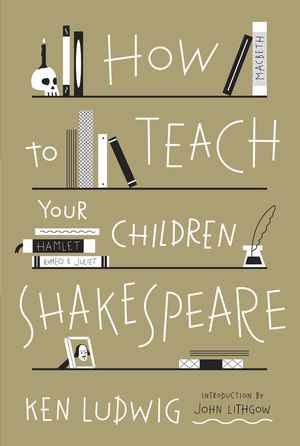 There are many ways middle-class parents in English Canada can improve the odds of their kids' success in the gruelling race of life. They can accept their children take French immersion, learn to play the piano, exercise yoga.
Memorizing Shakespeare would not seem to be high on the list of these useful activities. Nonetheless Ken Ludwig, a noted English playwright, in his How to Teach Your Children Shakespeare, believes it is every bit valuable every bit any of the above. He starts the book with ii premises that might arouse skepticism. The kickoff is stated by thespian John Lithgow in his introduction to the volume. "Children are ready, willing, and able to principal these 400-twelvemonth-old plays," Lithgow writes. The second is stated past Ludwig: "To know some Shakespeare gives you a head start in life." Once yous and your children have memorized some Shakespeare, Ludwig maintains, "Information technology will stay with both of you for the remainder of your lives. And it will modify your lives."
Ludwig has been teaching Shakespeare to his children since they were six years old, he writes. "It occurred to me when my daughter was in first grade that if there was whatsoever skill — whatsoever single surface area of learning and culture — that I could impart to her while we were both good for you and happy and able to share things together in a calm, focused, pre-teen way, then Shakespeare was it."
The key to learning Shakespeare was memorization. "In order to memorize something," he writes, "you have to work slowly and you take to understand every word of what you're memorizing." He notes, in passing, that memorizing used to be a standard tool of academic pedagogy — children were expected to learn hundreds of lines of poetry, in Greek and Latin and so in their native natural language. "This tradition has faded from our lives," Ludwig writes, "and something powerful has been lost." Ludwig's goal as parent and teacher was to accept his son and girl memorize 25 passages from Shakespeare.
At get-go sight this goal would seem to be ridiculous. Adults discover Shakespeare hard — how could children cope with the Bard? Fittingly for a how-to book, its writer has a few tricks up his sleeve. The offset is the utilize of what he calls "Quotation Pages." Here Ludwig breaks every passage "into brusque, logical chunks based on rhythm and pregnant," and then types these chunks on a sail of typing paper in a big font. (Needless to say, children learn the meaning of unfamiliar words in the passage before tackling these quotation pages.) The next step is for the children to say the lines aloud, assisted by the layout of the quotation page. The third step is for the children to repeat the lines again and again. "The repetition will pay off," Ludwig insists.
He begins this process with A Midsummer Night'southward Dream, a play he considers to be, along with 12th Night, the "well-nigh child-friendly of all the plays." In one passage the graphic symbol Theseus, a bridegroom, complains "But, O, methinks how slow/This quondam moon wanes!" In club to impress upon his children how the O audio echoes the sense of time dragging forth, Ludwig has them exaggerating the sound. "But, Oooo, methinks hoooow slooooow/This oooold mooooon wanes!"
Ludwig even suggests that the parent make it a contest among the children to see which of them can exaggerate the sound more. "Giddy, yep," he says. "Merely I doubt that they'll e'er forget the line afterward this." In general, Ludwig states, "Remember, always, e'er make the memorization a game for your children. Chest tones, patty-cake, marching, shouting, acting, wearing hats and cloaks, contests, bets, painting on mustaches, blackmail by chocolate, any it takes."
Is this really the best way to approach Shakespeare? Ludwig insists that children come to love Shakespeare through memorization, and maybe simply through memorization, and I have no doubtfulness that this is true. Prior to studying any paraphrased content, whatever search for patterns of imagery, any summation of themes, whatever tackling of Shakespeare's famous puns, must come the recognition in Shakespeare of sheer verbal rhythm and sound. Even the prose passages in Shakespeare reveal a richness of variable rhythms.
Ludwig of course discusses the poesy line known as iambic pentameter, Shakespeare's line and the standard line of English poesy, and demonstrates how malleable in the hands of Shakespeare this verse form is. Listening carefully to the audio and tempo of this heightened voice communication is the fundamental to understanding the characters and the plays. Although Ludwig doesn't mention this, information technology is also clear that the conscientious memorization of Shakespeare deepens awareness not only of Shakespeare but of the resources of the English in general.
In this age of inarticulate adolescents — nay, inarticulate politicians — such awareness surely gives an reward. Not that we want young people spouting Shakespeare at the slightest provocation — although that might non be such a bad thing — only that children who actually possess Shakespeare in a visceral fashion through memorization at least know what it is like to employ such poetic speech.
The gist of the book is independent in the first 30 or 40 pages. It may not have been necessary for Ludwig to expand it into book form. Nevertheless it is interesting to encounter how he approaches a range of Shakespeare plays. In Hamlet, for example, he urges memorization of Polonius's speech to his son — acknowledging that while Polonius is a windbag, the communication he dispenses is audio. In recently saying goodbye to his daughter, going off to college, Ludwig and his daughter exchanged memorized lines from that passage. "As she recited it, I started to cry," Ludwig recalls. "It was the greatest going away nowadays she could ever have given me." He hopes that, abroad at schoolhouse, she is even so following Polonius's advice.
Critical judgments of the plays inevitably announced, in sweeping style. "Comic writing simply does not get any meliorate than this," he writes of a passage from Twelfth Night. Much Ado Near Cipher "is the most surefire one-act Shakespeare ever wrote" — although A Midsummer Night'southward Dream and Twelfth Night qualify as "the greatest comedy of all time." Shakespeare's Falstaff, meanwhile, is "the greatest comic creation of all time."
Some negative judgments practise appear, although negative only in comparing to the heights of Shakespeare. The Two Gentlemen of Verona, for instance, is classed as "the to the lowest degree successful of Shakespeare's comedies."
As the quotations higher up indicate, one-act has a special fascination for Ludwig. He is peculiarly perceptive in comparing Shakespeare's comedies, with their hosts of improbabilities, their cantankerous-dressing and their mistaken identities, with some of the all-time screwball comedies of Hollywood, notably Some Like It Hot. This insight has the reverberant quality of Northrop Frye at his most brilliant. It is no accident that Frye found the clearest examples of his archetypes and symbols in archetype comedy. Frye, unfortunately, has been dismissed in academia in recent years and it is proficient to hear his works cited and his name invoked by Ludwig as a "great literary critic."
I have 1 quibble with the book. For some reason, he thinks kids tin skip Julius Caesar. "Get out this one to adulthood," he states. Now it just so happens the start Shakespeare I always read was Julius Caesar. I must have bought it in the Woolworth'due south paperback section — at that place were no bookstores where we lived — an edition of the play in The Laurel Poetry Series published by Dell, one of those 35-cent, slim paperbacks y'all could easily put into a back pocket. I never spent money better in my life.
I don't know why I bought it. High school was even so a means off and no one told me I should exist reading Shakespeare, and I was not a precocious reader. But the memory of that 35-cent book still charms. It was a nice thing to happen to me, reading the play.
But Ludwig nonetheless says leave Julius Caesar to grown-ups, I'chiliad non exactly sure why. But there'southward Shakespeare for you. He is inexhaustible not simply in himself but in the way he provokes heartfelt and sometimes odd responses.

Source: https://nationalpost.com/entertainment/books/book-reviews/open-book-how-to-teach-your-children-shakespeare-by-ken-ludwig
0 Response to "Teacher Says the Way I Sound Is Funny Walk Together Again"
Post a Comment